News about Rhino3D.Education:

Friday, November 11 2022

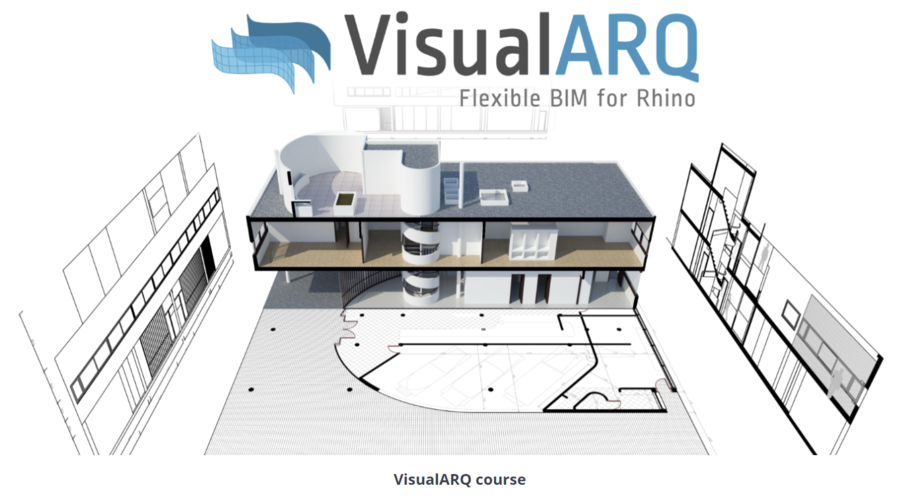
VisualARQ, Flexible BIM tools for Rhino

Learn all VisualARQ features to develop a project of architecture in 3D and all produce its 2D documentation

For more information and enroll in this free course, please go to: VisualARQ

Posted by: AT 02:10 pm   |  Permalink   |  Email
Email
Twitter
Facebook
Digg
LinkedIn
Delicious
StumbleUpon
Add to favorites

News about Rhino and all about training


The journal Computer Aided Geometric Design (CAGD) has announced a special issue on Applications of NURBS in Architectural Geometry, marking the 50th anniversary of Non-Uniform Rational B-Splines (NURBS).

For five decades, NURBS have played a central role in geometric modeling, enabling designers, engineers, and architects to create and fabricate increasingly complex forms with precision and flexibility. From early freeform design exploration to today's integrated design-to-fabrication workflows, NURBS continue to underpin many of the digital tools used throughout the architecture, engineering, and construction industries.

This special issue celebrates the enduring impact of NURBS on architectural geometry and invites contributions that explore both their achievements and limitations. 

Topics of interest include:
  • Surface modeling and rationalization
  • Precision fabrication and construction
  • Performance-driven and multi-objective design
  • Interoperability and digital workflows
  • Education and pedagogy
  • State-of-the-art reviews
  • Methodological advances
  • Built project case studies
The editors welcome submissions that highlight successful applications, discuss current challenges, and explore emerging approaches that may strengthen spline-based design and analysis in the future.

Guest Editors:
  • Konstantinos Gavriil (Executive Guest Editor), SINTEF, Oslo, Norway
  • Caitlin Mueller, Massachusetts Institute of Technology (MIT), USA
  • Iman Fayyad, Harvard University, USA
  • Jonathan Rabagliati, Foster + Partners, UK
Submission deadline: 30 September 2026


food4Rhino webinar: Reer – Moving Beyond AI Copilots in Rhino & Grasshopper 
June 10, 2026 at 5PM CEST

In 2025, people were still asking whether AI was usable in CAD workflows. In 2026, the question has shifted to how to make it more useful for creative work.

Reer is an intelligent design environment (IDE) for Rhino, Grasshopper, Revit, and more—where AI can collaborate with you on everything from modeling and analysis to rendering and documentation.

What You’ll See:
  • AI in Rhino vs. AI in Grasshopper: Watch Reer tackle the same modeling tasks two ways. Spoiler: Grasshopper doesn’t always win.
  • Turn Rhino into a BIM Tool: Learn how to make Reer master your project context, understand every object, and work like a colleague who already knows your file inside out.
  • AI x CAD Skills: Real-world examples from our users on what worked, what didn’t, and why collaborating with AI is becoming a skill every designer needs to have.
  • A Sneak Peek at the Reer IDE: Cross-file AI workflows, multi-Rhino sessions, Rhino-Revit coordination, and more.
  • Limitations of AI in CAD: Our unfiltered take on where AI still falls short in real workflows, alongside an open invitation for everyone to share their own experiences.

Join the Reer team for an honest conversation about AI in CAD, and walk away with ideas you can put to work today!

Speakers:

Connie and Shaw are the co-founders of Reer. As a team of former architects, interior designers, and product designers, they are building the platform they always wished existed. What drives them is simple: using AI to let designers think like humans again in CAD, without replacing the tools we all rely on.

Connie has a background in human-centered design and interior architecture, with degrees from Cornell University and the Harvard Graduate School of Design (GSD).

Shaw, also a Harvard alumnus, brings experience from Autodesk R&D alongside expertise in robotic engineering and computational design.


Dates: June 20–21 and June 27–28, 2026 (two weekends)
Time: 09:00–13:00 GMT
Format: Online (Zoom)
Language: English

Join this 16-hour online workshop and learn how to develop integrated computational design workflows for contemporary architecture using Grasshopper. As architectural projects become increasingly complex, designers need tools and methodologies that go beyond traditional linear workflows. This workshop introduces a computational design approach that connects parametric modeling, façade design, geometry analysis, data visualization, and automation into unified, adaptable systems. Through hands-on exercises and real-world architectural case studies, participants will explore how computational thinking can improve design quality, accelerate iteration, enhance interdisciplinary coordination, and support complex project delivery. The methodologies presented are informed by workflows developed for large-scale international projects, including projects at Zaha Hadid Architects.

Learning Topics

  • Parametric modeling and computational thinking
  • Data structures and information management
  • Adaptive façade systems
  • Geometry analysis and performance-driven design
  • Data visualization
  • Workflow automation

Module 1: Parametric Façade Systems

  • Establish flexible façade systems for rapid design exploration and iteration.

Module 2: Adaptive Systems

  • Create intelligent façade solutions that respond to changing design and site conditions.

Module 3: Architectural Case Study

  • Apply computational workflows to realistic architectural project scenarios.

Module 4: Integrated Computational Framework

  • Develop a unified workflow combining geometry generation, analysis, visualization, and automation.

By the end of the workshop, participants will understand how integrated computational design can support better decision-making, improve collaboration, reduce coordination risks, and enable more innovative architectural solutions.

Register here ...